Titus Willius
Back to Characters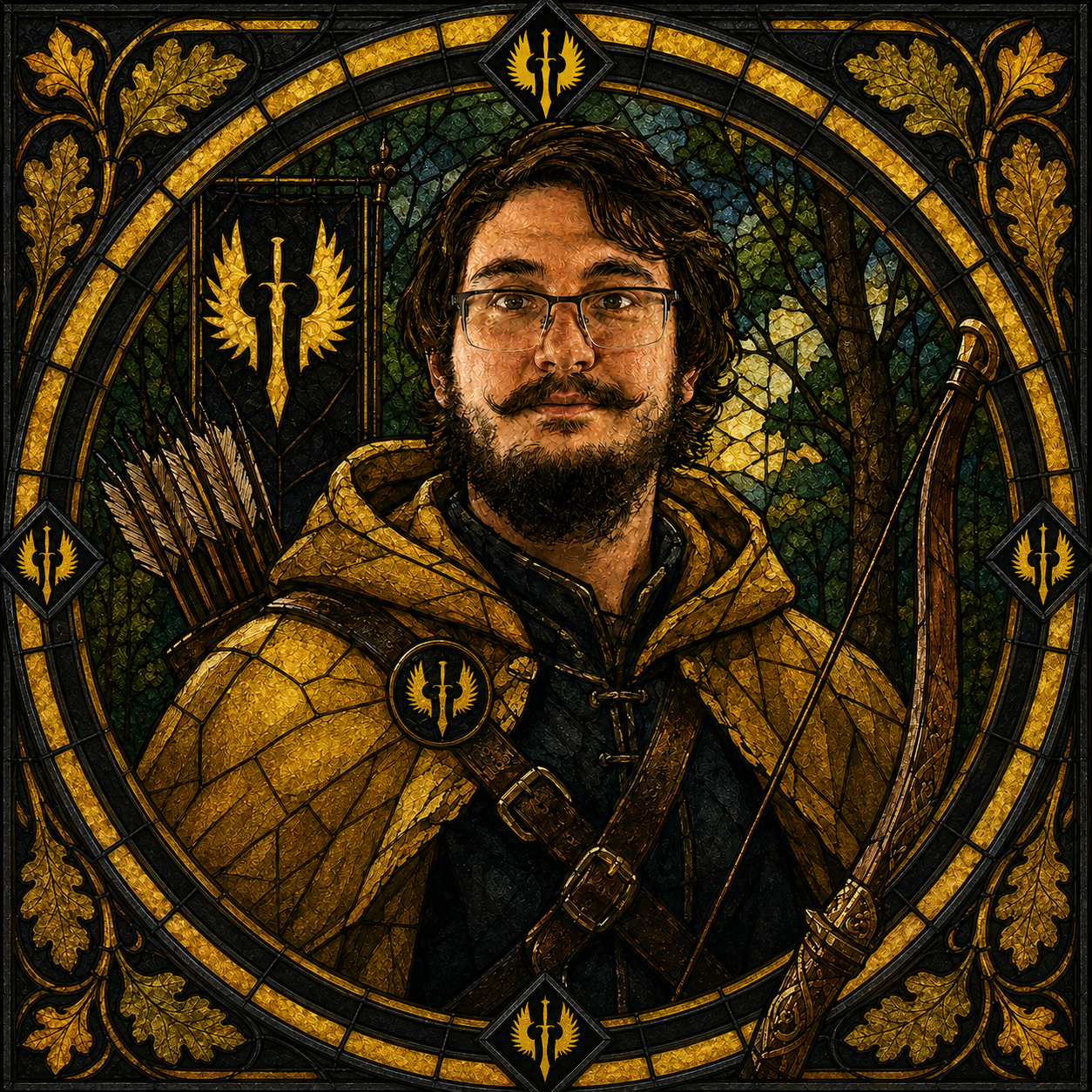
Origin Story
Titus Willius — The Righteous Bandit
Chapter 1 — A Crisis of Faith
Titus Willius was born in the year 998 to a farming family who held a modest plot of land along the troubled borderlands of a duchy. His parents were simple folk, faithful and hardworking, the kind who believed that if a man kept his hands honest and his prayers sincere, the world would answer with mercy.
But mercy grew scarce.
The Duke’s war had drained the land. Men were conscripted, grain was seized, and the farms that remained were forced to feed armies before families. Each season brought harsher quotas, heavier taxes, and colder visits from the Duke’s collectors. The peasants whispered that the war was no longer being fought for protection, but pride.
In 1013, when Titus was fifteen, blight took half the harvest. The settlement, already weakened by hunger, gathered in prayer and sent its elders to beg the Duke’s men for relief. They asked only for time. They offered faith, loyalty, and what little grain remained.
The Duke’s men answered with steel.
The settlement was declared disloyal. The farmsteads were sacked and promised to “worthier subjects.” Titus watched as his parents were dragged before the people they had fed for years and hanged as an example. He fled into the forest with his younger sister, carrying nothing but terror, grief, and the clothes on his back.
For many nights they wandered beneath the trees, cold and starving. Titus prayed for guidance, but heard no voice. He prayed for justice, but saw only cruelty. In that silence, something inside him broke.
Yet it did not turn him cruel.
It made him determined.
Chapter 2 — The Righteous Cause
Titus spent his later teens wandering from village to village, surviving on scraps, odd labour, and the rare kindness of strangers. His sister eventually found safety with a family of charcoal burners, and though leaving her wounded him deeply, Titus knew the road ahead was no place for her.
With no home to return to, he left his birth duchy behind forever.
During his travels, Titus met other broken families. Farmers driven from their land. Widows taxed for wars that had taken their husbands. Children hungry while storehouses remained locked behind noble seals. Everywhere he went, he saw the same pattern: those with power called their greed law, and those who resisted were branded thieves.
So Titus became what they accused him of being.
He joined a small band of outlaws who lived in the forests between lordly roads and forgotten villages. At first, he stole only to eat. Then he learned to choose his targets: tax wagons, cruel bailiffs, corrupt merchants, and men who grew fat from the suffering of others. What he took, he shared. Coin went to widows. Grain went to hungry farms. Medicine went to those who could not pay.
Some called him a criminal.
Others called him blessed.
Titus never claimed to be holy. He had seen too much blood spilled by men who spoke in the name of righteousness. But he believed there was still such a thing as goodness, and that goodness was not proven by prayers alone. It was proven by action. By standing between the weak and those who would crush them.
In time, he earned the name The Righteous Bandit.
Though skilled with knife and staff, Titus admired the bow above all weapons. To him, it was the weapon of the patient and the watchful. A bow could defend from the shadows, strike without cruelty, and protect those who could not raise a blade. Yet fate was unkind: his own bow was shattered during an ambush against the Duke’s men, and the outlaw band was scattered.
Once again, Titus was left with nothing.
No home. No weapon. No certainty.
Only his cause.
Chapter 3 — The Road to Bicolline
Rumours reached Titus of a place far beyond the lands he knew, a gathering of peoples, banners, guilds, warriors, pilgrims, merchants, and dreamers. A place called Bicolline, where a man could arrive with nothing and still choose what he would become.
To some, it was a place of war.
To Titus, it sounded like a place of judgment.
He set out with no coin, no horse, and no bow. Only the worn clothes on his back and the stubborn belief that a man who had lost everything could still be of use to the world. He walked the roads carefully, avoiding soldiers, helping where he could, and asking no reward beyond bread, water, and direction.
Titus does not come to Bicolline seeking glory. He does not seek a throne, title, or command. He seeks a bow, and with it, a purpose renewed.
He hopes to stand with those who defend the helpless. To loose arrows not for conquest, but for protection. To prove that an outlaw may still have honour, and that a man branded a bandit by the cruel may yet become a shield for the innocent.
He arrives as a stranger.
He arrives with nothing.
But in his heart, Titus Willius carries a vow:
Where the strong prey upon the weak, he will stand against them. Where fear silences good people, he will act. And should he find a bow worthy of his hands, he will become not merely a bandit, but a force of good.
Change Log
| Date | Type | Summary |
|---|---|---|
| 7 Jun 2026, 5:02 a.m. | created | New characters entity discovered |