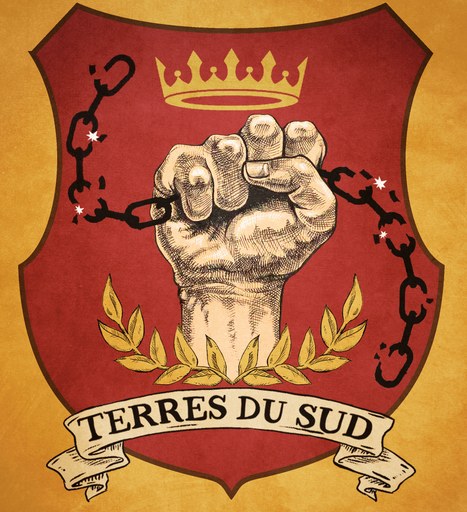
It is over large arid expanses of dry valleys and vast sandy areas surrounded by mountains and volcanic massifs that the City of Sands extends. Bounded to the east and west by the sea, to the north by a mountain range which separates it from the Territories of Oblivion and to the south by the Matidja massifs. With a very particular political system, the City of Sands has gone through history knowing how to adapt to changes. There is a tradition that the children of enemies are captured to be raised in a special contingent of the army, called the Janissaries. The title of Sultan is not hereditary and upon his death, a successor is chosen from among the Janissaries. However, this tradition has not always been respected and it has happened in the past that the Sultan's son succeeded his father.
The Land of Sands has a very particular political system. There is a tradition that the children of enemies are captured to be raised in a special contingent of the army, called the Janissaries. The title of Sultan is not hereditary
upon his death, his successor was chosen from among the Janissaries.
However, this tradition is not always respected and it has happened in the past that the Sultan's son succeeds his father. In addition, the assassination of monarchs and coups d'état are more frequent than in other regions of the world, although the current Sultan Nakkan Ossan reigns in a certain serenity.
Politics in the Land of Sands
Today, the Land of Sands is ruled by the Most Magnificient Prince Nakkan Ossan. Its capital is the city of Jabba Hal the Magnificent. The Infinitely Wise Nakkan Ossan administers Justice and the affairs of the Kingdom with the help of his advisors, the Emirs. To fully understand the Land of Sands, it is essential to understand how its ruler, the Sultan, is chosen:
The armies of the Land of Sands collect children abandoned by the enemy and train them to become part of the Jannissaries, the elite of the Sultan's armies. The Janissaries, who are therefore made up exclusively of former enemies, have great political power in Jabba Hal. It is from among them that the Sultan is selected, based on his skills, exploits and value.
Jabba Hal's law states that the children of a former enemy are free men. Since only former enemies can be part of the Jannissaries, their children cannot hold political office; consequently, the son of the Sultan cannot be Sultan. Thus, there is no hereditary monarchy in the Land of Sands; power is acquired by proof of a man's courage, skill and valor.
Furthermore, the power structure of The City of Sands replicates its inhabitants' entire way of conceiving the world; by taking the abandoned and rejected of the enemy to make them their own leaders, the Sand People apply a principle of Justice inconceivable in the Central Lands; take the weak from the enemy to make them strong on their side. This is all the wisdom of the Land of Sands.