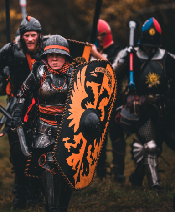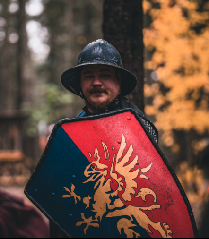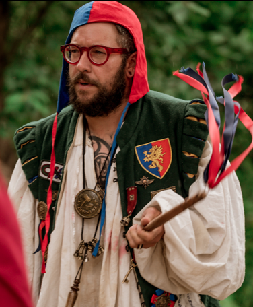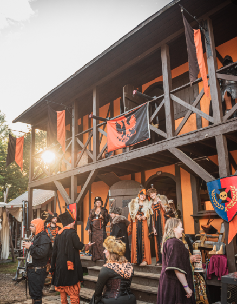
Empire
https://ghoria.org/gorghorbaey/ressources/archives/1001_garde_imperiale.pdf
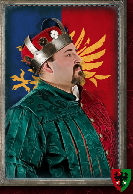

Monarkan I + Noger I - 200-310
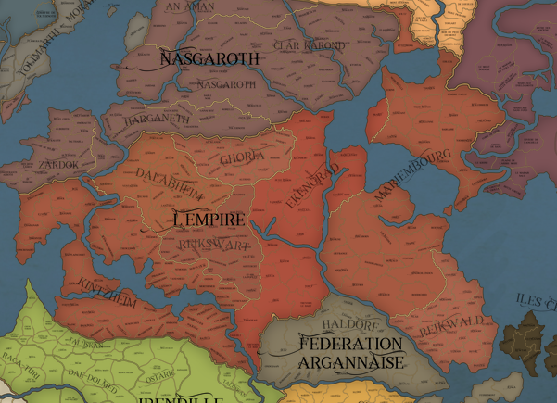
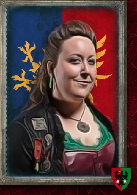
The empire traces its official roots back to the 200s when a determined young military commander, known as Monarkan 1st, declared himself Emperor. During the subsequent years, Monarkan expanded his influence by offering protection to settlers on his land in exchange for taxes. To streamline tax collection, he introduced the solar coin.
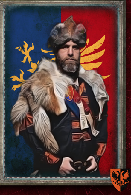
Monarkan I's son, Notger, Duke of Koenigsburg, harbored dreams of building an Empire stretching from one ocean to another. Upon his father's death in 297, Notger swiftly decided to conquer the north, with Nasgaroth, the dark elf country, as his ultimate goal. Encountering minimal initial resistance, he established a fortress bearing his name to serve as a base for Nasgaroth's conquest.
In 310, the dark elf queen, Malika, responded to Notger's invasions by declaring war on the empire. This conflict persisted for two centuries and several emperors, claiming Notger's life and depleting the imperial treasury. The war concluded in 512, but not a single domain of dark elf land had been successfully conquered.
Emperor Polignac - 512-600
Emperor Polignac was the one who ultimately withdrew from the northern conflict with Nasgaroth. Instead, he redirected his efforts to the south, encountering the blue men, an ancient civilization with territories rich in mineral resources. Unfortunately, the Emperor swiftly enslaved them, exploiting their resources, and many were sent to the diamond mines of Ekengrad.
With resources no longer drained by the futile northern war and the exploitation of their southern neighbours, the empire experienced a surge in wealth and power. Emperor Polignac left his mark on history by naming the most famous trade route after himself. Over several decades, the Empire expanded its dominion from north to south and east to west, becoming a formidable force. However, internal unrest began to grow. The southern imperial province of Andore resisted imperial rule, and provinces like Arganne expressed
increasing discontent with the cruelty of slavery.
In 607 of the First Era, the "Great Crossing" was organized. Emperor Polignac was nearing the end of his reign and wanted to fulfill one of his last dreams: to establish a maritime route between the lands of the central and eastern continents. This was accomplished, and it still exists today, connecting Pamoisard to Khadidja, an essential trading city between the city of sands and the lands of the center. It was called the "Two Islands Way" because of their discoveries during the great crossing. The Islands of Dalryada and Tarra were first discovered at the autumn equinox of the year 607 of the First Era. The first island visited was that of Tarra, and it was also the first to be placed under imperial control despite the opposition and resistance of its local population.
The annexation of the second island, Dalryada, to the Empire was much less straightforward. Very ancient families and clans were established there. These people had always lived off the work of their land and had never listened to any law but their own. There were several bloody skirmishes, but these people were farmers and had to resign themselves to the imperial troops.
Gar Dynasty - 600-1005
After Emperor Polignac's death, a new imperial dynasty emerged with Emperor Gar I who is most known for declaring war on Irendille in 640, citing official reasons like "lack of support in the war against the dark elves and poaching on imperial lands." However, historians believe the invasion was primarily driven by greed and a fear of being overshadowed by his predecessor. The people of Andore, having established good relations with the wood elves of Irendile, strongly opposed this declaration, leading to a general revolt in 642 across the empire, including the provinces of Ozame, Arganne, and Andore.
Gar I, consumed with suppressing Andorian resistance, almost forgot his conquest of Irendile, but not before committing massacres of the wood elves in the process. The imperial army gained notoriety for mutilating captured elves by cutting off their bow fingers. While Gar I temporarily subdued Andore, the province gained full independence in 712, just 30 years after his death.
From 999 to 1004, Gar III's reign faced various challenges. Tensions escalated between Dark Elves and the empire, with Prince Morath of Nasgaroth declaring war on both Gar III and the new King Solar of Andore over the loss of the dark elf artifact, the moonstone. The loss to the dark elves highlighted the divisions and wekanesses in the empire. The construction of the Port of Marienburg provoked the Orcs of the Forgotten Lands (Terres de l'Oubli), and discontent grew due to the treatment of slaves in the Ekengrad mines and the repression of dissent.
Gar III's political failures eventually led to his death. Prince Gabriel of the Phoenix, claiming non-payment by the empire, declared his intention to take his payment by settling Berkwald in 1003. The imperial council banned Gabriel from going to Berkwald, but undeterred, the Phoenix marched to Berkwald and defeated imperial forces who tried to stop them. Though contested, many believe it was the Phoenix who were behind the assassination of Emperor Gar III through poisoning, leaving only a child heir and chaos as his legacy.
Gorghor Bey - 1006-1011
Gorghor Bey, renowned as one of the most infamous emperors, started as a cruel leader of a mercenary horde that emerged in the late 900s within the empire. In 1001, he grew weary of the mercenary life and settled down to become the Lord of Ghoria. A year later, Gar III declared him the Imperial Regent. Gorghor's court quickly gained notoriety for its debauchery.
By 1004, Gorghor boldly claimed to be a God, creating tension with imperial guilds following the True Faith, notably the Poing de Fer. The True Faith labeled Gorghor Bey as an anathema, an enemy greater than the chaos troops of Garganesh or necromancers of Teratos. This sparked court conspiracies and proxy wars, intensifying the conflict between Gorghor's horde and the followers of the True Faith in the empire.
Emperor Gar III's mysterious death by poison threw the empire into chaos. A great inquisition by the Redemption against the imperial council uncovered evidence of Teratos infiltration, leading to the execution of most high court members in 1005.
With the path to the throne clear, Gorghor Bey proclaimed himself not only a God but also the new emperor. However, widespread dissent, particularly in the True Faith stronghold of Haldorf, resisted Gorghor's rule. This resistance led to a total war, culminating in the destruction of the abbey of True Faith founder Sainte-Abelle and the theft of the holy relic, the heart of Sainte Abelle herself.
Before long opposition had grown and Gorghor Bey was besieged in his own home. Despite facing military defeat, Gorghor achieved his true purpose. In 1007, he combined the heart of Sainte-Abelle with another artifact, the Chalice of Syrn, resulting in his ascension to the sun where his followers claim he now resides. The legacy of Emperor Gorghor Bey varies depending on who tells the story. Horde followers claim that consuming the heart granted him immense power, turning him into the sun itself. However, adversaries argue that becoming the sun was a form of punishment for his actions and he is burning eternally.
Karl von Schlaffenmark - 1012-present
Gaeriel Bartiz
https://ghoria.org/pages/evene.php?id_evene=215\&id_guilde=1000
In the summer of 1017, His Supreme Highness Karl Von Shlaffenmark, first of the name, decided that it was time the Empire was reunited to its fullness. The rebellious province of Haldorf, that had seceded in 1006, had to come back to the Great Empire. Imperial bureacrats were put to work and prepared an invasion plan.
On the first of may 1018, a great yell was heard in Phala, one of the domains in Haldorf. « JE SUIS GORGHOR BAEY! », the call of the once-Emperor, now God-sun, was so powerful it put the Phala dungeon to ruins. At the same time, more than a dozen Imperial banners marched into the rest of Haldorf bringing havoc and destruction. This was but the first of several seasons of imperial attacks on Haldorf.
The fight for Haldorf was also made on the battlefield at the Great Battle of 1018. Three battles were fought : on Tuesday, in the Segura valley, the Empire won 10 000 points to 1000. On Thursday, in the Nupe forest, the Empire won 10 000 points to 1000. On Saturday, at the siege of Nuur, it was a stalemate: since no side was able to get the three flags out of the castle, it was decided that the side that had been able to move one flag for 24 seconds would win the tie. The Empire had 5000 to 6000, for a total of all battles of 25 000 to 8000 for the Empire.
Before the beginning of the invasion in 1018, the province of Haldorf had close to 90 buildings and 160 military units. At the start of the 1019 Great Battle, Haldorf has less than 30 buildings and less than 30 military units. There are 13 imperial military banners in the province, while the province itself has only one banner left in defense. Ten or so domains have been razed to the ground by imperial troops, including the capital, Brahma.
One can be envious of the power of the Empire. One can feel intimidated by it’s sheer effectiveness. One rebellious mind can wish for it to be less tremendous. But one can’t ignore facts. Haldorf has been crushed by the will of the Emperor.
https://www.facebook.com/groups/2356986756/permalink/10157642292406757/
Imperial Treasury
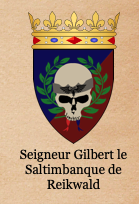
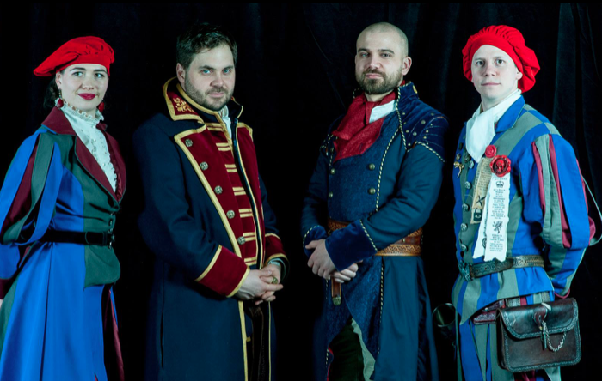
Following the appointment of Emperor Karl I, he will appoint Gilbert the Saltimbanque as treasurer of the Empire. He gives him the mandate to reestablish the institution of the Imperial Treasury, which will aim to re-institutionalize tax collection, the financing of projects supporting the imperial guilds, the financing of imperial war efforts and the reconstruction of the Empire following the invasions of 1012.
A fully independent guild, the Imperial Treasury has no other interest than ensuring the economic prosperity of the Empire. Since its creation, the Imperial Treasury has set up a surprising working capital, which it makes available to the imperial guilds.
The Imperial Treasury owns movable and immovable assets in almost all of the Imperial provinces.
Since 1015, the Imperial Treasury has also been at the head of the most powerful military house in Bicolinne, nicknamed the Imperial House.

The Reikskult or Imperial Cult is the official state religion of the Empire. It counts among its followers the most fanatical and loyal servants of the Empire as well as its most devoted soldiers and aims to promote the ideology and Imperial Kultur, to devote itself to
the Empire and/or the Emperor, as well as ensuring the moral and physical comfort of the imperial troops by sending its reikskaplans (imperial chaplains) to the front line. Its followers have faith in the Kaizergeist and are convinced that thanks to it “Reiks und Kaizer sind eist...” (The Empire and the Emperor are One)
attle of the mountains of Chkôl
Emperor Gar III's cousin, Inqul de Saqual exploited Ekengrad mines until his death. Every year under his reign, hundreds of slaves and prisoners of war fell under the whips. Malnourishment and exhaustion carried the others. Saqual was ruthless and his cruelty was equal to his wealth. More resilient, a few blue men survived detention, some managed to escape by diving into an icy vein of water, others were eventually released.
Fruit of the deaths of thousands of his fellows, Jaeir, the Blue Man, had swore to keep a secret on a treasure sleeping at the foot of the Chkôl mountains. But the Great Evil and Disease were right about his convictions: to take care of his relatives and his clan, he sold his secret. The location of the cache, where Saqual's spires dropped the precious ore, was now known. The information was sold and resold, and in a short time, groups of mercenaries set out. The bait of gain was great and the soldiers, seeking glory and battle, braved the forbidden, ignoring borders. Within a few weeks, hundreds of fighters scoured the mountains of Chkôl, in the north of Ekengrad province.
Chkôl mountains are said to be be bewitched, "relics" claim that a medallion and a parchment to open a passage to a place where no living being has entered. That said, the records date back to 1003 and it would be amazing to see these items reappear!
Ghoria: The conflict that is today known as the Battle of Orapal Tamas was not expected, at its beginning, to bring together hundreds of fighters and dozens of guilds. In fact, it wasn't even supposed to be a conflict. The Mages of Díedne, of whom I am a follower, had become aware of the existence of a crypt which, according to ancient texts, housed numerous objects with various occult powers. Wanting to know more and wanting to protect the Balance of the Worlds, we decided to walk towards the region of Eraldosse where the texts affirmed that this ancient school of Magic called Orapal Tamas was located.
What was only supposed to be a trip of study and exploration quickly became a conflict with major stakes. It is through extracts from my personal journal that I took the passages necessary to write this story. Without having the neutral character that History requires, you will still find in this work the broad outlines of this conflict. Do not look for impartiality or objectivity, they were not at the forefront of my thoughts when I noted certain facts. These are my feelings, my ideas and my opinions which form the story of my personal experiences relating, directly or indirectly, to the conflict which opposed us to the Salmarak guild and from which we emerged as big winners.
Adept of the Earth Sphere
Minister of Díedne
What led to war
Excerpts taken from my personal diary.
Year one thousand and two of the Central Lands, ninth day of the eleventh month, Domaine de Trappe, imperial province of Mariembourg
It's only been a few days that I've been enjoying the calm and comfort of my home in Mariembourg and nursing my wounds, memories, among other things, of our fights in Rissa against it's-we-don't-know-too- what about the Castenza (are they sailors, merchants, men of faith or fighters? Do they like Magic or do they not like it? Partisans of Queen Malika or King Léotaut?). A few injuries, but barely, and none serious, come to me from the conflict which opposed the Lord of Ghoria, whom we supported, and the Duke of Buy, where the latter showed, once again, his incompetence to carry out a successful military campaign.
So I'm quietly enjoying the end of autumn, a season that I prefer above all others. The eastern sea being only a few leagues from the estate that I manage on behalf of the Tower of Díedne, the autumn air is soft and pleasant. The surrounding woodlands are flamboyant with golden leaves, the bewitching smell of this season fills your nostrils with a pleasant aroma that words alone cannot describe and the behavior of the animals reminds us that winter and its difficult conditions will soon be over. our doors. Our farmers have been busy for several days harvesting grain and preparing their homes before the first snow falls. Even here, a few servants make sure that everything is ready for the arrival of the cold weather.
But, I who thought I could enjoy a peaceful winter season spent in front of the fireplace, studying the books that Mistress Yasraena left me, writing the story of our campaigns in Dendroica and those of Lord Baey in Reikwald as well as record the many ideas and rumors that populate my head, today I saw my hopes shattered. It was in fact at the end of the day that Elgar Victorinox, messenger from the Tours, arrived at the castle with in his bag a missive signed by the hand of Mistress Åsa, addressed to her husband, Egill Henrikson. The content, however, did not only concern him: Mistress Åsa brings the Council together at the Tower. It will therefore be necessary for us, Captain I-Hann Dragonar, Treasurer Egill Henrikson and I, to leave for Ghoria. This time of year which is so dear to me also means that once we arrive at our destination, we will have to stay there all winter, because the roads will be impassable. This fact does not displease me, since I will be both in the comfort of the Tower and away from the inquisitive gaze of my neighbors in the fiefdom. In fact, what I fear most is that we will be caught by the first storms. I don't particularly like the heat of summer, in fact I hate it, but I don't cherish the idea of having to travel in a blizzard any more. And since the province of Ghoria shares its northern border with the kingdom of Nasgaroth, winter hits mercilessly there, and early.
I must of course comply with the summons of the Mistress of the Tower and go to Bethel. Captain Dragonar has taken charge of the arrangements for the journey, which makes me believe that all will be well and that we will ride safely and quickly.
Year one thousand and two of the Central Lands, seventeenth day of the eleventh month, Domaine de Trappe, imperial province of Mariembourg
The preparations for the journey ahead of us are finally complete. It is with five Hecates, the soldiers of the Tower, that
we will travel to Bethel. A few soldiers will remain in Trappe to ensure that everything here goes in order during our absence.
The captain has established a safe and quick route that will avoid leaving the main roads. We will first join the imperial road of the Tracé de Polignac where we will ride west to Ekengrad and, from there, we will turn north towards the Chemin du Corlieu, to finally join Ghoria on the said path.
Despite my apprehensions about passing through the heart of the province of Ekengrad, newly under Redemptorist jurisdiction after mysterious events took place there in the village of Logneraie and the chaotic city of Garganesh extended its influence there, I must admit that Wardon Capum speaks the truth when he says that nine lightly armored people should not attract too much attention from the Lady's men, who have many other cats (rabid lions would be more accurate) to worry about. These arguments make sense, but as an Adept I will not feel safe until we leave Ekengrad. There is no doubt in my mind that our departure will not go unnoticed and that our ride will be under intensive surveillance.
Departure is planned for the day after tomorrow. Today the weather is gloomy, the rain is falling heavily and doesn't seem to be stopping any time soon. A north wind portends a rather unpleasant road ahead.
Year one thousand and two of the Central Lands, twenty-eighth day of the eleventh month, Trévoux-le-Haut Domain, Imperial Province of Ekengrad
Trévoux-le-Haut… This corner of Ekengrad at the foot of the mountains is not very populated, but we were still able to find a small and discreet village at the eastern end of Chemin du Pic. The locals told us that the place was once called Adamas, which in the old imperial language means "diamond." At that time, the region was rich in the numerous diamond mines that surrounded it, hence the name of the village. Then, around 950, when the imperial authorities lost interest in the mines which had been exploited as much as possible, the village, which emptied of its population, was renamed Fin-de-Pic, because it was located at The eastern end of Chemin du Pic. This name has stuck with him until today and in my opinion suits him wonderfully.
Lady Fortune having us in her good graces, we were relieved to find a small inn, deserted of course, apart from a few regular customers living in the tiny hamlet. “L'Auberge de la Pioche Brisée”, named thus since the fire which ravaged it twelve years ago, certainly does not stand out for the originality of its name and certainly does not allow its tenants to dress in gold, but it is nevertheless very welcoming. The innkeeper and his wife seemed very happy to see nine people arriving asking for meals, alcohol and rooms. I wonder, moreover, how many travelers can pass through here in a year. After all, there is nothing to see further apart from mountains and old abandoned mines. Perhaps some people tried their luck believing they had found diamonds. I doubt they found anything.
A downside, however. Yesterday, a soldier who accompanied us stopped the trip. He pointed to the east and we all looked there. In the distance, there was unhealthy-looking smoke, even at this distance, and everything around seemed dead. Thus, we were able to see, from afar, the extent of the devastation caused by the sacrifices at Ténamhuac, we had before us a desert of Garganesh. I have often said to myself that I would have to go and study these devastated regions one day or another, but this simple vision makes me fear that day which, I suppose, will come sooner or later, when I will have to tread on this blackened ground.
Plus, I can't help but imagine that men dressed in black and white are watching our every move. We can’t wait for us to reach Ghoria and finally leave the “Land of the Lady”!
Coming back to the trip, we traveled the Polignac Trail for seven days and left heading north four days ago. The first three days of the ride were very difficult because, although the weather was neither hot nor cold, we saw a few flakes, the rain often took over. Traveling wet in cold weather is a very unpleasant experience. Since then, the clouds have passed overhead without dropping any rain or snow. Today the sun was shining in the sky, making the trip almost pleasant. The captain estimates that we will reach the Chemin du Corlieu in ten days and, from there, the road to Bethel should take a week, at most.
Year One Thousand and Two of the Midlands, Twelfth Day of the Last Month, Gilam Dominion, Imperial Province of Ghoria
My biggest fear turned out to be true. At sunrise
Today, this morning, the snow started to fall intensely and the weather deteriorated very quickly. Towards midday, the road had become impassable and it became dangerous to continue. We therefore had to stop at a farm which ran alongside the path we were following. The Gilam Estate, where we are located, is only a day's walk from Bethel and the Tower of Díedne. Before they left for the kingdom of Ozame, the people of Gaia's guild were here the guardians of the forests of Duke Hyronimus of Forbach, who also owns Gilam. Perhaps this is why the road is a little less maintained as it enters the woods. Unfortunately, with this storm, I fear we will have to stay here for a few days. When we leave, our progress will be slow and difficult.
For the moment, I am enjoying the hospitality of the farmer and his wife, Niklas and Lea, as well as that of their five boys and three girls. The arrival of nine people could have put off more than one person, but the welcome they gave us warmed my heart despite the storm. The dinner was one like those of my childhood and the evening was rich in stories and anecdotes. When they learned that we were going to the Tower of Díedne, that we were living there, and that I was instructed in magical knowledge, some of them seemed fearful, but I was happy to correct some small erroneous beliefs. I-Hann and Elgar told them about some battles and military campaigns, Egill gave them several anecdotes in his own way and we briefly described life at the tower. Eventually, the father had to stop his children from asking questions. I sometimes miss peasant life without politics or military concerns. I know, however, that I could never return to such a life. I swam in the river of the political world, which led me to the sea of the world of Magic. I can no longer go against the tide.
Once the youngest had gone to bed, Niklas told me of his fear of seeing his two oldest boys conscripted into the lordly army. I looked at them both and told them that none of us could prevent them from serving under the banner of Ghoria if that was the will of the lord of the province, but that I could perhaps, at least, recommend them to the lieutenant of the Black Company, the independent mercenary troop of Lord Baey, or even to Don Miguel or Duke Hyronimus, the two highest authorities of the said company. I reassured them and let them know that they would be treated well there as long as they obeyed orders. I revealed to them that it was in the Black Company that Elgar and I experienced our first real fights and that, in the end, we didn't do too badly!
It's getting late and I'm falling asleep. A few days of work await us as we will give a helping hand to the people of this farm in thanks for their hospitality. However, I don't believe this is enough. So, I will talk to Egill and ask him to give them a solar for each member of the family so that the winter will not be too difficult for them. In addition, I will ensure that their stored grains and seeds are neither prey to rodents nor prey to disease. Next summer, their harvests will be lush…
Year One Thousand Two of the Midlands, Winter Equinox Tower of Díedne, Bethel Domain, Imperial Province of Ghoria
The precipitation turned out to be less than the storm led us to believe. We still stayed one more day at the farm and helped Niklas and his family put back in order everything that the wind and snow had damaged or made impossible to access. The solars that we gave them in gratitude for their warm welcome seem to have satisfied them.
When we left, we followed the road which, in the woods, was passable without too much loss of speed. The snowdrifts along the path allowed us not to get lost.
It was two days later, on the fifteenth day of the month, that we arrived at the Tower, exhausted but happy. I returned to my rooms with joy and was able to speak at length with Mistress Yasraena, telling her about the trip and questioning her about the reason for summoning all the members of the Council. On this, she would tell me nothing, except that a messenger had arrived two days before the storm, bearing a missive indicating that the Auvrindar Adept was a week's ride away.
Today was Equinox day and Mistress Åsa held the council at the zenith. I let Egill and I-Hann report on the situation in Mariembourg and listened attentively to Daerhaun's report on the situation in Rissa. It seems that the people of Castenza do not want to see Arganne shared and defended by more
several individuals, preferring to keep everything for themselves, at the risk of losing everything by being the only ones to raise arms against a possible invader. So, they are not ready to make any concessions and I sense a long political conflict looming on the horizon...
When all the members of the Council were in tune with the latest political events concerning the Tower, Mistress Åsa got to the heart of the matter. From a black leather bag, she took out several parchments and a somewhat faded grimoire. Master Boreas and Master Alvarez did not seem at all surprised, which leads me to believe that a meeting of the Masters of the Tower had been held well before the Council was convened. Mistress Åsa then revealed to us that she knew the location of an ancient school of magic where dozens, even hundreds of objects with various powers would have been kept safe and that these objects were just waiting to be found. This school, Orapal Tamas, would have been destroyed during the great conflict which pitted the Empire and its southern provinces against each other. The Mistress of the Tower closed the session by giving us all a document recounting the history of Orapal Tamas. Nothing, however, about how the documents came into his hands. Everyone is entitled to their secrets and it would have been rude and perhaps even imprudent to ask too many questions at this time. Before leaving, I looked at each of the masters and none seemed surprised by the news. I think the captain and the treasurer noticed it too.
A vote will take place on the last day of this year to decide whether the Mages of Díedne will mount an armed expedition to search for these almost forgotten objects. It’s a safe bet that this will be the case.
Year one thousand and two of the Midlands, twenty-fourth day of the twelfth month Tower of Díedne, Bethel Dominion, Imperial Province of Ghoria
I have read and reread the documents concerning Orapal Tamas. It is surprising to note that such a great school of Magic could have sunk into such… profound oblivion. It is true that the year 640 was rich in various events: wars, coups d'état, betrayal, resounding victories and crushing defeats. I will transcribe here the main lines of the history of this mysterious school.
Orapal Tamas was one of the greatest esoteric schools in the Middle Lands. All the great masters of the schools of thought of Kalt and the followers of the teachings of the red breath were trained there. The masters of Orapal Tamas devoted a large part of their lives to studying and collecting objects holding occult powers. In the year 647, in the heart of the Dark Ages of the Central Lands, the school was completely destroyed as the region was ravaged by the armies of the northern and southern provinces. The school was never rebuilt and the villagers who survived the conflict left the region permanently to settle on more suitable land.
The stories tell that the masters of Orapal Tamas had all the magical objects they held protected in a crypt which they walled up at the start of the great revolt in the year 640.
According to archives and the statements of certain copyist monks, the crypt houses several hundred parchments, potions, talismans and magical weapons of various origins.
Last day of the year 1002 Tower of Díedne, Bethel Estate, Imperial Province of Ghoria
The Council meets again today. The decision was quickly made to set off an expedition to recover the objects from the crypt beneath the Torascon plain. Everything will be planned as soon as possible. Everyone at the Tower, from the citizen to the master, including the guard and the apprentice, will have to carry out their tasks with more professionalism than before. The task before us is of great importance for the preservation of the Balance of the Worlds.
Year One Thousand and Three of the Midlands, Twentieth Day of the Year Tower of Díedne, Bethel Domain, Imperial Province of Ghoria
The masters, the Tower Council as well as several soldiers will leave in the coming days for the port of Pamoisardl where the festivities at the Auberge du Galion will be held in two months.
Year one thousand and three of the Central Lands, twenty-fifth day of the second month, Domaine de Trappe, imperial province of Mariembourg
While other inhabitants of the Tower continue their journey towards Pamoisardl, I return to my domain to inquire about the latest news. Although there have been some deaths of children and elderly people due to severe flu, it seems that everything is going well. My farmers are preparing for the arrival of spring which, according to the predictions of the elders, will occur very early this year. Indeed, although in Ghoria there was a lot of snow, it seems that the rigors of winter spared the east of Ekengrad as well as Mariembourg. The mountains and the sea air are a blessing. I leave
today towards the Auberge du Galion. I will have to push my mount to the limits of its strength, which I hate to do, but the situation demands it: I cannot miss these festivities! With a few words, the right words, of encouragement, my horse should come out of this with a need to rest for a few days, nothing more.
Year one thousand and three of the Central Lands, eleventh day of the third month, Ranvier Domain, Imperial Province of Reikwald
I have been staying at the Auberge du Passeur for three days, a very popular establishment since its owner also owns two boats allowing people to cross the Reikwald to the port of Pamoisardl, all for the modest sum of 20 coins. This man must be very rich, even if he doesn't show it.
Elgar met up with me this evening to update me on the latest events and news. It seems that everyone from Díedne who was supposed to go to the Galleon got there in perfect condition. Six horses are said to have died during the journey, four due to wolf attacks. So it's nothing too dramatic. Already, our treasurer is reportedly concluding several commercial agreements. Master Alvarez and Adept Auvrindar have resumed negotiations with the people of Castenza, including Duke Morgul DuDrake himself. Maybe this situation will get resolved one of these days.
Everything couldn't have gone so well... The Messenger of the Towers told me that a persistent rumor was that sailors had heard of an underground cavern where a great magical treasure was hidden. Said sailors, still according to rumor, would like to get their hands on the treasure. The people at the Tower are investigating, but everything matches too much for it to be just a coincidence. I should be in Pamoisardl in two days at most. It's urgent.
Year one thousand and three of the Central Lands, Spring Equinox, Domaine de Butasard, Argan province of Dendroïca.
The Galleon festivities are finally over. What exhausting moments, but oh so satisfying! If only to see old acquaintances again, the trip is worth every effort!
An agreement was finally possible between us and the Castenza guild. The Adept Auvrindar, head of the domain of Butasard, has placed his signature alongside those of the other landowners of the fief of Rissa to appoint Bastian Oséric, Castenzians and count in Nasgaroth, as master of the fief. This is an important agreement and one less case on the shoulders of the Council.
The importance of this news was confirmed a week ago, during the culminating moment of the Galion festivities, during the big banquet organized by the port leaders. Indeed, while Adept Auvrindar and I were both in the middle of a discussion, we were interrupted by men of Duke Salmarak of Buy who happened to pass by. One of them, completely drunk, insulted the Auvrindar Adept by attacking him for his nature as a dark elf and his smell. The latter didn't respond, just stared at the drunk. For my part, I told the one who supported his colleague that they would do well to look elsewhere if we were there. Unfortunately, the one who could hardly stand on his legs began to insult the Adept of the Sphere of Souls again. Again and again weak insults compared to its smell. It goes without saying that the lexical field of these sailors without a boat is very limited and is close to that of the peasants when the time comes to fertilize the fields, although I know many peasants whose list of insults originals is very impressive! And I who believed that sailors were colorful people and that this was reflected in their language... I will have to find time to study this environment, perhaps I have only witnessed the exception which confirms the rule ? Perhaps the frustration of the men of Salmarak is only the fact of knowing that they have navigating ancestors, but of not having any ships? Or even their accumulated defeats, such as Liberec, in the year 1000, where we, mercenaries hired by the Duke of Buy, waited in vain for him and his men before deciding, finally, to confront the troops of the Order of the Redemption alone (what a massacre…); or even Reikwald, in the year 1002, where the political weight of the Horde of Gorghor Baey earned Salmarak a crushing and complete defeat while they were crushed under the number of allies of the lord of Ghoria? So many hypotheses, so many possibilities...
So in the face of such big mouths and such little wit, I couldn't help but respond. Not to defend the Auvrindar Adept, who could have done it himself if he had thought it was worth it, but simply out of principle and because I had, at the moment, nothing more important to do. . Of course, Mistress Yasraena would not have approved of my actions, she who finds me too impulsive and impatient, but since she is not
unspeakable.
Certainly, the fact that the Salmarak guild sees its income and production reduced to nothing should rejoice me, because they are now our avowed enemies. But too many innocent people died needlessly in these events, far too many...
And on a purely political (and religious) level, Garganesh's curses are not to help us. The Holy Order of the Iron Fist, armed arm of the True Faith, is likely to unite with Salmarak in this ordeal. Only time will tell, but I believe that the battle that will take place in Eraldosse in a few weeks is, for us, lost in advance. The True Faith, and especially the Iron Fist, is a little cousin of the Order of Our Lady of the Redemption and losing the military support of these two experienced guilds in Salmarak would represent, in my opinion, an almost certain defeat, since it must be taken into account that they will probably bring other factions with them. However, I believe that it is not impossible to convince Redemption of the merits and advantages of fighting on the side of the Tower of Díedne.
In three days, I will leave Trappe with many peasants and soldiers to join the rest of the inhabitants of Díedne in the Éraldosse region. Very few people will remain behind, as very few remained at the Tower: we are going to war.
Year one thousand and three of the Central Lands, tenth day of the seventh month, Trévoux-le-Haut Domain, Imperial Province of Ekengrad
I joined the ride four days ago. All the Mages of the Tower of Díedne are gathered and it is under guard that we march openly towards the crypt of Orapal Tamas. On the way, I was told two important pieces of news and, as nothing can always be perfect, there was good news and, of course, bad news. The good news, or rather the excellent news, is that our friends and allies in Fhaín, barring an improbable
exceptional change in the situation, are giving us their almost unconditional political and military support in the coming conflict. With each passing day, it seems that the relationship between the Magi of Díedne and the Fhaín continues to grow stronger. This is a good agreement destined to last. Long live Fhaín!
For its part, the bad news is rather worrying. It is common knowledge that the Salmarak Guild will refuse to engage and even negotiate with so-called chaotic or evil troops. He is as well known to all as we Mages of Díedne know him. It would seem that, seeing their value diminish since one of the two sides will refuse to pay them, the troops of chaos are at work and are discussing the creation of a third front. During almost every major conflict, there is a rumor of an additional front which will be created by people who are dissatisfied and unable to have everything they want to obtain. These fronts are rarely realized, being too complex to organize and, above all, often being forced to be composed of too few fighters to achieve an unexpected victory. However, the troops in question today are said to be chaotic, but some of their elements are good military strategists and would be able to rally many warriors to their cause. If it came to fruition, this front, even with few combatants, would ensure our military defeat. Worse than a military defeat, the Balance of the Worlds would be even more in danger if such an army were to seize the treasure of Orapal Tamas. For either of our two adversaries to possess all of these artifacts would mean the coming of catastrophes that we can barely even imagine. We could laugh at the Great Khan's past curses because they seem so minor to us.
Year one thousand and three of the Central Lands, thirtieth day of July, Region of Éraldosse
Camp is set up. The region is still rather deserted, but will not remain so for long. Our scouts report several troop movements converging towards us. It seems we are ahead of the bulk of Salmarak's troops. They certainly have a few spies and scouts around, but their army is still several leagues from ours.
Tomorrow, I will go to the Torascon plain to note the particularities of the land and its surroundings. All the greatest known generals spent more time preparing for battle than fighting. If I can help Mistress Åsa and Captain I-Hann be recognized as great generals, even if only by providing them with a detailed map of the region, I will be more than happy.
The days pass and I fear for our future. How could we win with empty coffers? I don't know what the Council is planning, but they will have to pull off a major feat. Salmarak is much richer than we are and, as if that were not already enough, they are supported by the strength (and fortune) of Brabancourt.
Year 1000
.......................................
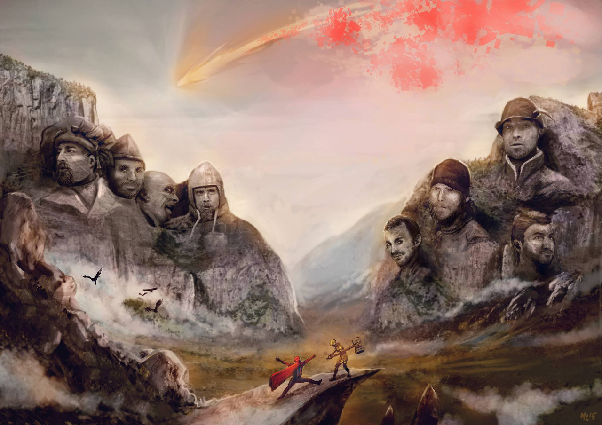
Mount Reiksmore is a giant sculpture made from the mountain on the Wilz estate, in Mariembourg, in honor of the Cairns of Fjallhret Campaign, which opposed the forces of the imperial province of Mariembourg to those of the province of Trisen in Berkwald.
It represents on the left the imperial party: His Serene Highness Karl I, Gilbert of Reikwald, the ReiksKomissar Tarek as well as the ReiksMarschall Ivan Ulyanov. On the right are the Berkwaldian forces: The mage I-Han Dragonnar, Dagmar of Rochelures, King Gabriel of Berkwald as well as Dillios of Trisen.
In this representation of Mount Reiksmore, we can admire Captain Empire fighting Gunnulf of the Pack at the front. In the sky, we discover Butasard's Comet bringing in its wake the seeds of destruction.
https://ghoria.org/pages/ressource.php?id_guilde=1000\&id_ressource=107
n the mountain range of the Monts Ventoux separating Trisen from the Imperial province of Mariembourg there is a mountain called Fjallhret. The largest of the peaks making up the Monts Ventoux, Fjallhret was often considered a mythical place by early man, its massive shadow falling over the Wiltz valley and its perpetually snow-covered summit lost in a heavy blanket of clouds.
“We don’t survive Fjallhret.” Let's say the veterans of the region, referring to the countless explorers and fools who got lost in the snow while trying to cross to the Berkwald from Mariembourg without going through the Gorge du Chat. Goat paths exist all along the mountain range passing under the shadow of Fjallhret, of course, but a single wrong step and it is death for the too intrepid. For travelers coming from Trisen, the game is doubly risky: the winds sweeping the northern facade of the Monts Ventoux are icy and hail and blizzards are common in this region.
Until recently, no one had the desire or interest to venture into these hazardous paths...until a band of shepherds returned to the villages of Wiltz with stories of a necropolis in the side of the mountain. Cairns containing riches untouched for millennia, in the very heart of the mountain range, at the foot of Fjallhret!
The rumor quickly spread, and Imperial antiquarians confirmed the authenticity of some of the objects and artifacts found. Small trinkets, a few gems, but also a few scrolls and rings containing a certain magical power.
The Emperor himself urgently dispatched the League of 45 to elucidate the mysteries of Fjallhret. If anyone could brave the mountain and find the mystical cairns, it was this elite troop. She would be joined for the crossing into Wiltz by the Mariembourg and Imperial forces who would use brilliance and technology to cross in 'relative safety' the cliffs surrounding Fjallhret.
On the other side of the massif, Trisen's forces had also learned of these cairns. The Mages of Diedne therefore mounted an assault force to explore the ruins, when soon the rumor that the Empire was already on its way reached their ears. The magic of Svirin allowed them to protect their forces from the unleashed elements and to arrive at the plateau dominated by Fjallhret, where the Imperial host was already deployed. Fjallhret had for years been a disputed territory between the two provinces and although it had never been of real interest in the past, the discovery of these Cairns renewed the disputes over the real owners of the mountain.
The Mages of Diedne and the League of 45 therefore agreed on a traditional fight: A struggle between their two forces amassed at the foot of Fjallhret, following which the victorious front could claim the Peak—and the precious ruins—in the name of its province. The fight would be fierce, and the furious elements would play against both camps in this war.
“You can't survive Fjallhret. »
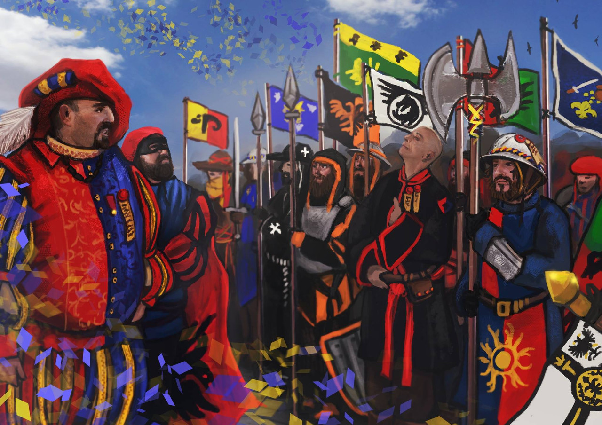
A fresco depicting His Serene Highness Karl I of the Central Lands reviewing the troops. We recognize behind His Highness the Captain Empire. Among the troops, we distinguish the colors of Aries, Dragon Riders, Hellequins, Ragnarok, Kabbalah, Von Shlaffenmark, https://ghoria.org/universite/1016_hibou_proces_gaeirel.pdfArmateurs de Ranvier and Gorghor Baey.
Slavery -
Commission of Inquiry into the Segregation of Slaves in the Empire
Introduction
His Serene Highness, undisputed Ruler of the Central Lands, known as The Deified, The Serene, and The Benevolent, Revered Emperor Karl I ordered that a commission of inquiry into slavery be established following the Purple Ball of the year 1017 The aim being to assess whether this practice was still relevant in the Empire. This mandate was granted to the Silver Owl.
Four Commissioners were appointed: Elwen Rilya (Imperial Treasury / Tirion) Ulvain Passievol (Silver Owl), Aléanir Sonastran (Vand'Hal), and Êve la Bohème (Silver Owl).
A qualitative questionnaire with 13 questions was distributed around the world in order to collect different points of view. It is understood that the information collected during this survey is confidential and will be anonymized as part of this report. In order to avoid any possible conflicts, only those responsible for the project will have access to individual responses and they will subsequently be filed under lock and key in the Vault of the Library and Archives of the Silver Hibou (BAHD), annexed to the School. of Cutting-edge Universal Research on Technologies, Innovations and New Observations (THE ERUPTION). The laboratory technicians who participated in the transcription of this survey received credits as part of the Empire Integration Program (PIE).
This investigative report presents the XIII questions, an analysis of the answers and XIII recommendations on Slavery in the Empire.
Analysis
I. The respondents
Out of fourteen participants, five indicated having a position against slavery, five for slavery, and four having an ambivalent response to the question. There were also eight Imperial respondents, which we believe provides adequate representation of all positions.
II. The Rights and Obligations of Slaves
In general, respondents agree that slaves have the right to have their basic needs met (although the notion of what a basic need is can change depending on the work performed by said slave). They also have the right to obtain the necessary elements to properly carry out their work (e.g.: tools to work the land, education, etc.), as well as having the immense privilege of accessing some of the state services and facilities paid for by the taxes of all good imperial citizens.
Since slaves do not have control of their freedom, they have the obligation to follow what their master requires of them. They must also respect imperial laws, as well as the obligation of loyalty to our Emperor.
In both cases, a prior explanation of his rights and obligations must be given to a new slave at the start of his service.
III. The needs of slaves
The majority of respondents agree that slaves had basic needs. Some even indicate that if the slaves' needs were more than met, it was reflected in the quality of their work. The great theorist Mazlowix established that humanoids have different basic needs, whether at the physiological, protection or recognition level. Here is a short summary of his thoughts, adapted for slaves:
5 - Physiological - Eat, drink, sleep, breathe, dress
4 - Being protected by your master.
3 - Have a group of slaves, rather than just one, to encourage a sense of belonging.
2 - Recognize the value of your work for the Empire.
1 - The possibility of freeing oneself and realizing oneself by becoming an accomplished imperial citizen, and having the privilege of paying one's tax.
It is the responsibility of the master to ensure that the first four levels are in place for the slave and that the last level remains accessible.
This commission of inquiry would not be possible without the precious support of laboratory assistant 163 as well as the teachers of the Silver Hibou
IV. The end of a slave's debt
There does not seem to be a consensus regarding the end of a slave's debt. Some believe that the debt should function as a kind of contract: at the beginning of the service, the master and the servant agree on the different terms to be fulfilled in order to end. Others believe that the liberation should take place after the costs of acquiring and maintaining the slave have been reimbursed. Finally, some more severe masters believe in slightly more radical aims, that is to say that the debt can only end upon the death of the slave or according to the good will of his master.
For many of the respondents, it was appropriate for a slave's debt to be passed on to the next generation. However, as the ages of majority and separation of children are unclear, we believe that debt should not be transferred from generation to generation.
V. Breeds
Although it is recognized that some breeds may have
see characteristics giving them an advantage in accomplishing certain types of tasks (e.g. an orc's strength can be useful in more physical work), a strong majority of respondents agree that no race is more better than any other to become slaves. It is important to remember that a race's propensity for slavery is not an indicator of productivity.
VI. Identification
Once again, opinions on marking a slave to identify membership are not unanimous: some recommend it, some do not, others have no precise opinion on the subject.
However, we note that this type of practice can temporarily reduce the slave's productivity due to the convalescence time, as well as hinder his potential to become an accomplished imperial citizen. Additionally, removing marks can be a costly process for the state. This is why it is suggested to use alternative methods such as:
- chains on the feet;
- Haircut;
- the simple oral mention on the part of the slave; - magic marking.
VIII-I. Use of force
The majority of respondents did not encourage the use of force. When this is done, it is suggested that the force used be proportional to the fault committed.
This commission of inquiry would not be possible without the precious support of laboratory assistant 163 as well as the teachers of the Silver Hibou
VIII. The sacrifice
Almost all respondents did not believe that sacrifice had any use, whether it was a peasant or a slave.
IX. The economic argument
The responses on this subject were most interesting.
Some interesting facts to consider:
>Peasants, by being Imperial citizens, pay Imperial taxes, while slaves use the services our taxes pay for.
>Slaves must be “supervised”, whether by military personnel or supervisors of some kind, which generates additional costs.
X. Free time
Respondents consistently mentioned that a slave's ability to have free time should be determined by their master. The servants can then do a multitude of activities such as:
Meet their needs and regain strength;
Clean up their neighborhoods;
Pray (ideally to the Emperor);
Pay taxes;
Study the laws and regulations of the Empire in hopes of becoming a freed Imperial citizen.
XI. The freeing of slaves
The majority of respondents agree that Education is the preferred method of manumission, followed by manumission through military service. A few mentioned prayer.
However, we note that a simple release is also a very acceptable method when the slave deserves it following work well accomplished.
XII. The Rehabilitation of a Freedman
Rehabilitation methods are expensive, according to several respondents. However, as the guidelines and costs are not detailed by the majority of respondents, it becomes difficult to address this subject. One thing is certain, the majority of respondents indicated that it is natural for the master to offer a work contract to the freedwoman.
This commission of inquiry would not be possible without the precious support of laboratory assistant 163 as well as the teachers of the Silver Hibou
Recommendations:
I. It is recommended that slave masters have the privilege of paying a tax on their behalf, since it is the master who is responsible for the slave and his rights, and must therefore pay the tax.
II. It is recommended that the methods of manumission and debt settlement of the Empire's slaves be clarified and that those who comply with the methods receive a tax holiday in respect of their slaves. The abolition of intergenerational debt bondage is also recommended.
III. It is recommended that masters encourage their slaves to meet their basic needs so that they will eventually become accomplished and exemplary Imperial citizens.
IV. It is recommended that masters hold a contract for each of the slaves they have indicating their debt and expectations regarding their manumission, signed in 5 copies in blue or red ink, in order to respect the bureaucratic measures of the Empire .
V. It is recommended to avoid the sacrifice of slaves, since they can eventually become accomplished imperial citizens and pay their taxes at the same level as a peasant.
VI. It is recommended to discourage the race-based slave trade.
VIII-I. It is recommended that masters avoid permanently marking their slaves and opt for an unsafe method.
invasive, at minimal costs.
VIII. It is recommended that a newly freed slave be able to enter the ranks of the Imperial army.
IX. It is recommended to avoid the use of force against a slave, since
e injuries can slow down work and cause a loss of income and efficiency.
X. It is recommended that the minimum age for hiring a peasant or the use of a slave either the age of the majority of the empire, or the age when he obtains the right to pay his taxes.
XI. It is recommended to avoid forcibly sending slaves into military ranks, in order to leave room for proud imperial citizens who wish to defend their Emperor and their homeland.
XII. It is recommended that the Empire focus on the proliferation of peasants and sailors, rather than developing the internal slave trade.
XIII. It is recommended that the Empire work towards establishing a slave manumission program as soon as possible.
This commission of inquiry would not be possible without the precious support of laboratory assistant 163 as well as the teachers of the Silver Hibou
Conclusion
The four commissioners unanimously concluded that the Empire should consider gradually decreasing their use of slaves. However, we are aware that suddenly stopping this method is not easy for everyone. The challenge is therefore to move towards a reduction in the use of slaves, and possibly towards a form of non-slavery.
Thanks
We would like to thank the following participating guilds for their time and response, which allowed us to advance knowledge on the subject of Slavery:
Smart Bag, Swordsmen
The Order of Our Lady of Redemption
Yamina, Borderers of Irendille
The Mule, Kabbalah
Dofleini Toweenar 28th, Voelhoorns
Gilbert the Saltimbanque, Treasury
Imperial
Chenopodiasee Von Wasmeier, Mages of
Diedna
Saïd Bassam Ibn Abdi Al Zarqawi, Emissaries of the City of Sands,
Angelo (xjhdsaf), Riders of the Goat
Von Shlaffenmark Ham, Broken Finger
Ludwig Von Shlaffenmark, Von
Shlaffenmark
Vasily Krinkov, Hellequins
Ocelus of the Griffon, Griffon
Iardawen Eldaloth, Borderers of Irendille
We would like to particularly thank His Serene Highness, undisputed Sovereign of the Central Lands, known as The Deified, The Serene, and The Benevolent, Revered Emperor Karl I for his enlightenment regarding the need to question the situation of slaves in Empire, without whom this commission would never have seen the light of day.
Deposited with the Imperial Council, in the year 1018 of the Great Battle
https://ghoria.org/universite/1016_hibou_proces_gaeirel.pdf