Terres du Sud
Prehistory: year 0-1010
The origin of these lands, like all of Mundus, is shrouded in myth and mystery. Because of the self-imposed isolation and lack of record keeping of the tribal people, the oldest known residents of these lands, we may never know the true history. However, we are able to infer certain truths from archeology and anthropological study and through the oral tradition of modern day descendants of the original inhabitants.
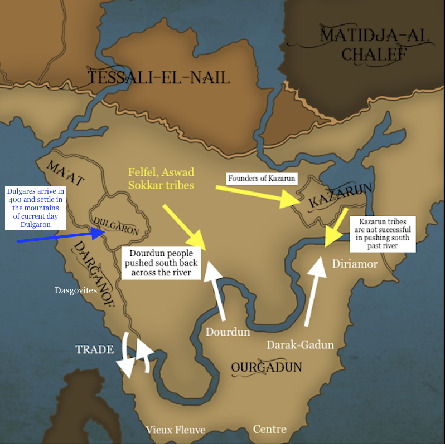
The People of Ourgadun are the oldest known inhabitants of the area. Divided into five large tribes, their territory extends from the south-east of the Ourgadun river to the Cite de Sables province of Matidja-Al Chalef. The People of Ourgadun do not trade or associate with the rest of Mundus, except near the Darganof peninsula where some trade posts exist. There was a time when the Dourdun tribe occupied a vast territory north of the river, but they gradually abandoned it in the face of deeper and deeper incursions by the tribes of Felfel, Aswad and Sokkar. These last tribes are at the origin of the province Kazarun. During the following history, some attempts were made by the founding tribes of Kazarun to push their incursion south beyond the river, but they were met with fierce resistance from the people of Ourgadun and the attempts ended in failure.
In the year 400 the Dulgari settled in the northwest, mountainous region of the country. Oral histories relate that they arrived by sea, having left a land northeast of the Forgotten Territories. The Dulgares are a robust people living mainly from working the land. Like their southern neighbours, the Ourgadun, the Dulgares maintain almost no contact with other peoples. In recent years, the Boboliche region has welcomed several Dasgovite families to these lands as well as other men and women from other regions who have decided to settle there.
Some stories also relate that when the Dulgari left their lands they took the staff of Garon-Ga, the last magical artifact of this people, as well as the ashes of the last patriarch. They were buried in the heart of the Gotwald region as soon as they arrived more than 600 years ago.
More recently, people have arrived fleeing Imperial oppression from Arganne, Kafe and elsewhere. The result is a country of rich cultural diversity and hardy, freedom loving peoples.
Reign of King Rathan: 1010-present
The Provinces of Dulgaron and Darganof Declare Independence - 1010
Landing in the Darganof in the year 1010, Rathan dreamed of founding a nation where all those who thirst for justice and freedom could find home. In 1011, he made an alliance with the rulers of the neighbouring province of Dulgaron by signing the charter of the independent country of Terres du Sud denouncing the current rule of Sultan Nakkan Ossan. In the year 1012, the citizens of the provinces crowned Rathan and officially made him their King.
War with the Sultan - 1013
After the people of the Terres du Sud chose Rathan Rex as their new king, a series of uprisings began against the Sultan Nakkan Ossan of Jabbal Ha who claimed to be the ruler of the provinces. Almost two years of war followed where King Rathan led our people in a war that erupted into a global conflict which would eventually see the Sultan forced to recognize the independence of the Terres du Sud.
In the province of Dulgaron, Prince Resther Saint-Felix was informed of an attack by Sultan’s men, the Guerriers de la Montagne, and issued a royal proclamation summoning all of Dulgaron’s nobles to defend the province. Unsurprisingly, l’Ordre Notre-Dame de la Rédemption in Dulgaron did not only ignore his summons, but turned on the Prince, joining the Guerriers as they marched towards Gotwald Fortress in the heart of Dulgaron, intent on razing it to the ground.
With all the nobles of Dulgaron united except la Rédemption, the Guerriers de la Montagne forces were weakened, outnumbered and desperate. In a final push they attempted to enter the capital through the sewers where they were slaughtered to the last man by the freedom-hungry populace.
Following the battle of Gotwald, the provincial council composed of the l’Arrogance, the Garde Rouge and the Ost du Saint Reliquaire decided to divide the fiefdoms of Dulgaron among themselves and the council of Dulgaron turned their eyes eastward, towards the province of Kazarun, the jewel of l’Ordre Notre-Dame de la Rédemption. The unforgivable betrayal of the Redemption in Dulgaron made the council determined to make those who wanted to take their freedom pay.
Chasing out the last of the Sultan’s forces
After the victory of the forces of Darganof and Dulgaron against the armies of the Sultanate which had come to quell the rebellion, Rathan sent his best men in pursuit of the fleeing forces.
In the vast expanse of the Desert of Ma'at that separates the Cites de Sables and the Terres du Sud, the King's troops caught up to them but were overwhelmed by the numbers of the Sultan’s troops. The King headed deep in the Dulgare Mountains where he had the advantage. A place of red canyons and unforgiving sun, the Abu-Akr Rifts north of Darganof and Dulgaron was perfect for leading the defence against the Sultanate armies. After several days of battles in the scorching heat, the forces of the Terres du Sud Indépendantes were on their way to repelling a third invasion of the province as the Traquers emerged victorious.
Displeased with the Sultan’s weakness, rumours of sedition and revolt against the authority of the Sultan spread north through the lands of the Cite de Sable. In response, the Sultan continued to try to crush the Sudiste forces while fortifying his territory and calling on old allies to aid him including l’Empire who unhesitatingly supported him. In the great global clash, the Sultan was able to just barely hold on to his power but he was forced to acknowledge his loss of the Terres du Sud. From now on, the country would be recognized as free.
Liberating of Kazarun - 1013-1014
Although the war with the Sultan had ended with a peace accord, conflict still raged across the land. The armies of Dulgaron, Ma'at and Darganof now marched on the independent city of Kazarun, stronghold of the forces of l’Ordre Notre-Dame de la Rédemption, in revenge for their betrayal during the war and to liberate those that still suffered under the tyranny of the Sultan.
One of the most decisive victories was scored when the mage Clars F. Lester cast an arcane spell all the way from the Sublunar Manifestation of the Galactic Nexus in Gotwald with a spell so powerful he was able to flood the Kadar mines, destroying the wealth and forces of our enemies.
Taking advantage of the total destruction of the armies of the Redemption by Clars’ magical attacks, the whole of Terres du Sud began their assault on Kazarun. While the Berserks were busy ransacking the Lubsko estate and the Kadar mine was taken by arcane forces, the forces of the l’Arrogance and the Garde Rouge laid siege to the country estates of the Redemptoristes. Soon the fortress of Freiberg was all that remained of their holdings in Kazarun and they began preparations for a long siege.
While the forces of the Garde Rouge and various southern factions were busy drawing a trail of destruction across the province, eventually occupying the estates of Wurzen, Grima and Soltberg, the forces of the Traqueurs and Berserks began the final siege of Freiberg.
Besieged for several months, the provisions of the great fortress of Freiberg grew low but still a year long siege seemed likely until the day when the skies over the territory were set ablaze by celestial flames, originating back in Gotwald at the Galactic Nexus, the home of the mage Clars F. Lester
When the devastating attack ended, the fortress still stood but the city was in ruins. The Redemptorists who had survived the obliteration left the safety of their dungeons to survey the damage. They were surprised, however, by the Sudiste survivors of the final battle with Sultan who had taken a detour to aid in the efforts to free Kazarun. Led by King Rathan, they swooped down on the smoking ruins and crushed the remaining Redemption forces. With this final victory, a unified Terres du Sud finally emerged.