
Cite des Sables
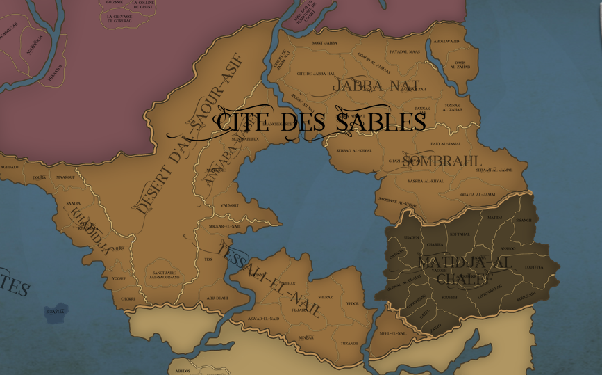
https://ghoria.org/gorghorbaey/ressources/nakkan/index.htm
Mythic Beginnings
It is said that at the Origin of the World, the Creator had contained a part of his Wisdom in a Magnificent Diamond. Each facet of this Diamond reflected a vision of What Is, and it had been bequeathed to the Princes of the World to help them govern men with lucidity. This Treasure attracted covetousness, because it was said that inside it were also contained What was and What will be. A magician hungry for the power that knowledge of What Will Bring would bring him used a Genie's wish to obtain the Diamond. As a second wish, the magician asked the Genie so that he could see what was inside the Stone. The unfortunate man found himself a prisoner in her heart. Aware of the lesson that the Genie had just taught him, he took the time to think carefully about the formulation of his third wish. He wished to be placed in a place outside the Stone from which he could see each facet of the Diamond. The Diamond then flew into thousands of shards the size of a grain of sand; and so great was the Diamond and filled with Wisdom, so many grains of sand spread over the region and formed the Land of Sands. Thus, it is said in this Country that each grain of the desert contains a part of What is, What was and What will be.
It is on large arid expanses made up of dry valleys and vast sandy areas surrounded by mountains and volcanic massifs that the Land of Sands extends.
It is over large arid expanses of dry valleys and vast sandy areas surrounded by mountains and volcanic massifs that the City of Sands extends. Bounded to the east and west by the sea, to the north by a mountain range which separates it from the Territories of Oblivion and to the south by the Matidja massifs. With a very particular political system, the City of Sands has gone through history knowing how to adapt to changes. There is a tradition that the children of enemies are captured to be raised in a special contingent of the army, called the Janissaries. The title of Sultan is not hereditary and upon his death, a successor is chosen from among the Janissaries. However, this tradition has not always been respected and it has happened in the past that the Sultan's son succeeded his father.
Geography
It is bounded to the east and west by the sea, to the north by a mountain range which separates it from the Unknown Lands and to the south by another mountain range separating it from the countries of Kazarun and Dulgaron. However, there are two geographical elements within the Land of Sands which deeply mark it: The Dark Sea, a large salt water lake fed by underground arms of the ocean which divides it to the south in the middle, as well as the Al-Saour-Agif desert, uninhabitable, which also divides it in the north in the middle. Most of the country's coastline is made up of reefs, and few places are suitable for the establishment of a large-scale port, with the exception of the port of Sombrahl in the east.
Since time immemorial, the Mesh-Mesh Mountains have served as a natural border between the City of Sands and the Forgotten Territories. Rumor has it that nomadic peoples have tried, on several occasions, to establish routes and watch posts there, but goblins always ended up attacking and plundering the region in search of treasures and equipment. https://ghoria.org/pages/evene.php?id_evene=255\&id_guilde=1000
Since time immemorial, the Mesh-Mesh Mountains have served as a natural border between the City of Sands and the Territories of Oblivion. Rumor has it that nomadic peoples have attempted, on several occasions, to establish routes and watch posts there, but the goblins always ended up attacking and pillaging the region in search of treasures and equipment.
Recently, adventurers' reports were intensifying in the taverns of Aghbalu; green-skinned beings had been seen in the mountains and were calling their allies to them. Had they found the lost treasures that legends have described for ages? Were they simply seeking to establish a passage point to reach the beautiful Khadidja? Regardless of the reasons, the Arrachés would be on site before Karn Gobo's allies could take position; speed was of the essence, as the war drums were already echoing throughout the valley.
https://s3.ca-central-1.amazonaws.com/bicolline-static/media/campagne16juin2018-ArrachesVSKarnGobo.compressed.pdf
Politics
The Land of Sands is divided into 6 Emirates, three in the east and three in the west, separated by the desert and the inland sea. Each emirate is divided into a number of principalities, the equivalent of "fiefdoms" in the Empire or Andora. The majority of the emirates in the Land of Sands are relatively wealthy, although there are large disparities between rich and poor emirates. Sultan Nakkan Ossan rules the country from the capital, Jabba Hal the Magnificent. The Sultan is the undisputed leader in all areas of life in the Land of Sands.
The Land of Sands has a very particular political system. There is a tradition that the children of enemies are captured to be raised in a special contingent of the army, called the Janissaries. The title of Sultan is not hereditary
upon his death, his successor was chosen from among the Janissaries.
However, this tradition is not always respected and it has happened in the past that the Sultan's son succeeds his father. In addition, the assassination of monarchs and coups d'état are more frequent than in other regions of the world, although the current Sultan Nakkan Ossan reigns in a certain serenity.
Politics in the Land of Sands
Today, the Land of Sands is ruled by the Most Magnificient Prince Nakkan Ossan. Its capital is the city of Jabba Hal the Magnificent. The Infinitely Wise Nakkan Ossan administers Justice and the affairs of the Kingdom with the help of his advisors, the Emirs. To fully understand the Land of Sands, it is essential to understand how its ruler, the Sultan, is chosen:
The armies of the Land of Sands collect children abandoned by the enemy and train them to become part of the Jannissaries, the elite of the Sultan's armies. The Janissaries, who are therefore made up exclusively of former enemies, have great political power in Jabba Hal. It is from among them that the Sultan is selected, based on his skills, exploits and value.
Jabba Hal's law states that the children of a former enemy are free men. Since only former enemies can be part of the Jannissaries, their children cannot hold political office; consequently, the son of the Sultan cannot be Sultan. Thus, there is no hereditary monarchy in the Land of Sands; power is acquired by proof of a man's courage, skill and valor.
Furthermore, the power structure of The City of Sands replicates its inhabitants' entire way of conceiving the world; by taking the abandoned and rejected of the enemy to make them their own leaders, the Sand People apply a principle of Justice inconceivable in the Central Lands; take the weak from the enemy to make them strong on their side. This is all the wisdom of the Land of Sands.
Tolerance and prosperity
Economy
Trade and slavery
In addition to its natural resources, the Land of Sands became extremely rich through trade and slavery. Strategically placed between the Middle Lands and the Outer Worlds, the port of Sombrahl is an inevitable stopover for all trade from the Westlands (and the Outer Worlds) to the Empire or Andore.
Among the goods transiting from the Outer Worlds, we note silk, porcelain, tea, rag paper, but also ivory, gold dust, spices, pearls and precious stones. The volcanic mountains north of Jabba Hal are also rich in gold and precious minerals. Finally, the coasts of Pays des Sables are ideal for growing figs, tangerines, olives, dates, and other products typical of tropical areas. Furthermore, one of the trades contributing to the wealth of the Land of Sands is the trade in man, that is to say slavery. Legal (and even valued) in these lands, this trade benefits greatly from the location of the Land of Sands, the gateway to the Empire of the Outer Worlds.
However, as the port of Sombrahl is the only port able to accommodate very large ships (likely to face the perils of the sea), almost all trade in goods within the Land of Sands passes through the latter. Thus, the majority of goods coming from the emirates in the west of the country pass to the east by sailing through the Dark Sea
Culture
One of the salient characteristics of the Land of Sands is Tolerance. All religions and races are tolerated in the Land of Sands. Each religion is free to practice its doctrine, and members of all religions can practice whatever profession they desire. The Land of Sands has greatly benefited from its openness to the world. Jabba Hal welcomes many merchants and adventurers from around the world and is full of treasures and wonders. Trade has made the Land of Sands a rich and prosperous nation. Goods from the east are transacted through Jabba Hal before traveling to the Central Lands via the sea route of the Two Islands or that of the Seahorse. Ships from the Pays des Sables thus take precious commodities from the east to the commercial route of Polignac, which crosses the Empire: silk, porcelain, tea, rag paper, but also ivory. , gold dust, spices, pearls and precious stones.
In this area as in many others, the Land of Sands has been served by its tolerance. From all over the world, scientists and scholars have fled intolerance and fundamentalism to take refuge in Jabba Hal. With the result that La Magnifique has one of the largest libraries in the known world (with 400,000 volumes, it is said to be larger than that of Gar III), and numerous universities, schools, and libraries. It is in Jabba Hal that many documents were kept which were destroyed elsewhere in the world during the Great Darkness and the abuses of the Inquisition. This is also where scholars can think and develop their theories without fear for their lives when they see that reality is outside the credo of pushy dogmas. Thus, it is at Jabba Hal that progress is born in many sciences such as mathematics, geography and medicine. It is also where some of the most illustrious contemporary scholars reside or have resided, such as Alhazen (Opticae Thesaurus), Rhazès or Al Khwarizmi. Crafts are also flourishing in the Land of Sands. The quality and finesse of the worked leather, fabrics as well as the goldwork (particularly copper) Jabba Halliennes are recognized throughout the world of Bicolline. Without forgetting the architecture, which has produced several masterpieces; vaults, domes, remarkable mosaics, all following elaborate geometric principles.
Emir Jazzaar Hezaam Al-Maqad
Sultan Nakan Ossan
Born in the Central Lands, at the age of five he saw his family abandon him and flee before the soldiers of the Almighty Prince Nakan Ossan of Jabba Hal. The Sand Men's custom is to collect captured children to make them soldiers, he had the Honor and the Chance to become a member of the elite of the army of the Supreme Sultan, the Jannissaries. In this military corps, he learned combat, but also the power of the mind and diplomacy.
A simple soldier, he was sent to the border province of Kazarun, whose borders were apparently threatened by the neighboring country. Once there, he realized that the local lord had invented this threat; he used this pretext to bring together a few shabby extremist lords, scheming to overthrow the Benevolent Prince for their benefit. They raised a pitiful rebel army there, while the neighboring countries were more afraid of knowing this power at their gates than they were threatening the Kingdom. Aware of the subterfuge, Jazzaar Hezaam Al-Maqad cut off the heads of the leaders of the rebel movement and delivered the rest of the renegade forces, now devoid of a general staff, into the hands of the enemy forces - revealing to the latter the positions of the army traitor...
He thus returned alone riding to Jabbal Hal the Magnificent, taking to the Glorious Sultan the heads of the renegade lords as a pledge of the end of the conflicts with the Kazarun. The Benevolent Prince Nakan Ossan filled with Wisdom noticed Jazzaar Hezaam Al-Maqad and appointed him Emir, integrating him among his personal advisors.
The Argane Liberation Campaign
Today, Emir Jazzaar Hezaam Al-Maqad is given the role of Ambassador of Jabba Hal and representative of the Transcendent Prince Nakkan Ossan in the Argane Liberation campaign. The Beneficent Prince Nakkan Ossan having seen the troops led by Viakta defend freedom and be annihilated by the tyrannical forces of the imperialist lords, His Majesty decided to establish himself in the Central Lands in order to share the Wealth coming from Freedom and of Tolerance, which are virtues acquired in the Land of Sands. He chose the area of Argane for geographical proximity, but above all to take it as an example, since taxes there are three times higher than even in the surrounding monarchical regimes. The Great Prince intends to offer this country freedom from totalitarian oppression, but also economic prosperity through the unparalleled trade possibilities of Jabba Hal, as well as cultural prosperity through the exchange of science and good graces between the 'Argane and the Magnificent City.
His Splendid Majesty also emphasizes that no harm or harm will be done to the good people of Argane, and that his armies will only fight those who raise arms against them. The Salvetier Prince Nakkan Ossan intends to bring freedom and prosperity to the people of Argane, and he has taken the means of a quick and decisive victory to avoid causing them harm. The Exalted Prince is also counting on the enthusiasm of the liberated peoples, who are invited to take up arms against their oppressors. It has happened many times in the past that Jabba Hal's troops were welcomed with open arms by the people they came to liberate, and that these people fought on the side of the Sultan's armies against the monarchs who should have been their protectors. For this represents the very spirit of the Land of Sands; take the weak and the oppressed and make them Strong.
And to those who do not fight for their freedom or for any cause other than their own, he reminds that he paid 12,000 solars to the Horde of Gorghor Beay so that the latter assembles a force capable of realizing the virtuous intentions of his Generous Magnificence.
Jabba-Hal the city with golden roofs!
Just by its pronunciation, the mind flies towards this mythical city and our imagination gives way to a thousand and one images taken from the incredible stories surrounding it. This will be the second time in its history that the doors of the city have been opened in this way, to all known delegations from around the world. The first meeting dates back to the last century during the Al-Zahab summit. One hundred and seventeen years have passed since such an event. The excitement and excitement are palpable throughout the markets, souks and alleys of Jabba-Hal. In addition to the presence of illustrious ambassadors and guests from our world, all the major tribes will meet on this occasion. The Wajid, Al-Khyal and Fayad families, the Grand Vizier Uzgurl and his Emirs, as well as the great line of Nakka princes will be present. This amplifies the rumors about the presence of His Serene Highness Sultan Nakka Ossan. Rumors suggest that the Sultan would come in person to illuminate with his presence the festivities of the great ball of Jabba-Hal. If this turns out to be true, it would be an extremely rare and exceptional event. To all of you, adventurers of Bicolline, we await you at the city of sands where you will be received in the abundance and splendor of the Magnificent Jabba-Hal! Come dressed in your best clothes to celebrate, discover, frolic, play, feast, create, meet, embody, woo and dream!
The location of the city of Jabba Hal may seem strange, since it is located in the middle of the desert. However, several geographical, religious and economic factors explain this choice. It is located on the site of a large Oasis with inexhaustible resources that give life, in the middle of the desert. The abundance of this Oasis has given rise to many myths concerning the appearance of the Wonderful City. Its creation is often attributed to magical spirits, sorcerers, or even geniuses.
This place is also justified by the presence of the Philosopher's Stone in its center.
Its geographical location is closely linked to its wealth since it is located near the northern mountains of the Land of Sands, which abound in gold powder and precious ore. Thus, the lucrative trade in these resources is carried out from Jabba Hal the Magnificent and has enriched the city's coffers for centuries. It is a city of extremes where poverty and great wealth coexist. Reflecting its fortune, the city is also known as the “City of Golden Roofs”.
Current Events / international relations
1015 - aeadim wujud alshsharaf!
This is what the close advisors of His Serene Highness Nakkan Ossan said when the precious camel arrived in the city. Several years ago, His Highness gave Aljaml, the largest and strongest camel, to Emperor Karl I. Unfortunately, the beast returned to the country in a somewhat lamentable state and a decree of dishonor was pronounced.
The advisors of Emperor Karl I responded that the creature was too frail and too weak to be seen as a worthy gift. It was decreed that the Sultan had to withdraw his remarks and that men would ensure this. An imperial contingent under the command of Ragnarok therefore headed towards the city of sand, the Sultan's defenses awaiting them to protect their sovereign from this threat. (Gift dishonor)
Provinces
Province d'Annaba-Jabel - White lions province - This emirate is located in the northern and western rims of the Dark Sea (the eastern coast belonging to the Emirate of Sombrahl). Surrounded on all sides by the Al-Saour-Agif desert, only the region located near the Dark Sea is inhabited. Its inhabitants live in austerity and are representative of the traditional way of life of these countries; we could describe the emirate as the “Land of Deep Sands”. A few villages along the Dark Sea serve as staging points for an overland trade route to the west that is more dangerous although less costly than the port of Sombrahl. This trade route is a risky alternative for trade from the eastern Dark Sea emirates to the (minor) ports of the Khadija Emirate.
In addition to the desert itself, from which violent sandstorms regularly blow, the main danger for the inhabitants of this region are the Saoures, the inhabitants of the deep desert, who are not subject to the law of the Sultan. More information about them is available in the section dealing with the Al-Saour-Agif desert.
Al-Saour-Agif desert - We could consider the Al-Saour-Agif desert as the “7th emirate” of the Land of Sands. The climate in the desert is unbearable, the aridity extreme. The inhabitants of the Land of Sands never venture there. Travel between the eastern and western emirates is almost entirely via the Dark Sea (except for the pilgrimage to Jabba Hal and some risky land trade expeditions). The rule of the Sultan does not extend into the deep desert, although there are persistent rumors that it is inhabited by lawless desert men, the Saoures.
The stories surrounding the desert dwellers are very real, the fearsome Saoures inhabit the desert of Al-Saour-Agif and they have no rival there. Only coming out at night, they quickly became the center of the scariest myths one can hear in this part of the world. Twice a year at the summer and winter solstices the Saoures lead nocturnal attacks against the emirates. That of Annaba-Jabel has most often been the victim of the sandmen, and their attacks always result in the disappearance of old people…
Khadijia - The emirate of Khadîdja is a prosperous emirate. Located west of the Land of Sands, on the shores of the Inland Sea which separates the Westlands from the Inland Lands, it benefits from the mildest climate in the Land of Sands. This climate is suitable for growing many foodstuffs specific to warm climates. However, the region's coastline is almost entirely rocky cliffs, and there is a small harbor allowing ships likely to pass through the rigors of the Inland Sea to dock. But the sea route passing from Khadîdja to the Empire is much more perilous and much less frequented than that passing through the Dark Sea then through the Emirate of Sombrahl. Thus, the majority of the region's goods transit east to the port of Sombrahl. - es Émissaires de la Cité des Sables
1010 - he Cité des Sables is at the dawn of a new boom, after having experienced, in recent years, a significant wave of new arrivals in Tessali-el-Nail and Annaba-Jabel. This new population base initially created a cultural shock, but also caused strong tensions between the recent arrivals. For several months, the situation has calmed down, even allowing a wind of stability to blow over the region. His serene highness Nakkan Ossan, judged the moment opportune to invite not only the emirs of the City of Sands, but also dignitaries from other regions of the world, to this sumptuous celebration which will be held in Khadîdja, the pearl of the desert. Obviously, this evening will be an opportunity for the Sultan's representatives to announce important news affecting the City of Sands, but also to honor, as the Sultan wished, personalities established in his emirates.
In order to underline his new openness and vision of the world, His Serene Highness Nakkan Ossan intends to mark the spirit of the invited dignitaries, and this in a masterful way. During the evening, the post of Emir of Khadîdja will be given to the one who can demonstrate his or her devotion to the Sultan. To do this, he will have to seduce his guests through rhymes of meshmesh poetry, so dear to the ears of his serene highness. In addition, he must succeed in surprising them with an unusual present.
It goes without saying that entertainment, music and exoticism will be part of this long-awaited evening.
1017 - hadidja, the sublime gateway to the Orient. From the four corners of the world, gigantic sailboats crisscross the seas in search of its secrets. On board these ships, men hungry for wealth and hope. Who has never dreamed of these lively souks, of these intoxicating hamams, of sudden wealth that could be won at the bend of an alley in the merchants' district? Who has never dreamed of letting the days flow, in the heart of the Saour country, towards the mystery and the history of the marvelous Khadidja?
But everything is not all wealth and pleasure in Khadidja. Beneath its haunting and vaporous airs a war of power is playing out which constantly opposes the members of the court, the sepium sellers, the bloodthirsty mercenaries and the dancers as charming as they are fatal.
You are all invited to come and share, for an evening, the flavors and perfumes that make Khadidja the Sublime gateway to the Orient, the City of pleasures.
The emirate of Matidja-al-Chalef would be a prosperous emirate, if not for its constant political instability. A border emirate, it has traditionally been a “barrier” which defended the Land of Sands from its southern neighbors, the country of Kazarun. Thus, there is a tradition of warrior tribes that is very useful in times of war, but problematic since peace was made with Kazarun around twenty years ago. There is no strong central power in the emirate of Matidja-al-Chalef, and the Emir, himself barely stronger than some of the other tribal leaders in the region, must deal with vassals constantly looking for belligerents.
emirate of Matidja-al-Chalef - A few years ago, a rebellion formed in the emirate of Matidja-al-Chalef. Several tribal leaders banded together to gather an army under the pretext of unrest from the neighboring country of Kazarun and a possible threat of invasion from the Land of Sands. However, Kazarun was very peaceful at this time and was rather worried about this military gathering. The leaders of the rebel army actually intended to overthrow the Sultan's order in their country and undoubtedly then challenge his authority.
However, a Janissary dispatched to the site, Jazzaar Hezaam Al-Maqad, realized the subterfuge and revealed the position of the army to the enemy, who was able to attack it during the night and eliminate it. In this way, Jazzaar Hezaam Al-Maqad “single-handedly” put an end to an internal revolt and was therefore appointed advisor to the Sultan. Following these events, the Sultan placed his nephew at the head of the emirate, and the latter reigns ruthlessly over the tribes of the region, supported by the royal troops.
Sombrahl -It is said of the Emir of Sombrahl that he is undoubtedly the 2nd richest man in the Eastern Lands (after the Sultan, of course). The Emir of Sombrahl made his wealth by specializing in one of the most lucrative trades there is, the trade in human life. The second reason for the wealth of the Emir of Sombrahl is his port, located on the west coast overlooking the ocean. The Emir of Sombrahl is a very influential man in the Land of Sands, and many whisper that if it were not for the fact that he is the cousin, he would be interested in the Sultan's throne.
The port of Sombrahl
The port of Sombrahl constitutes the only truly large port in the Land of Sands because of its rocky coasts. As the Land of Sands is practically bisected by the impassable desert of Al-Saour-Agif, all trade in eastern Sandland, whether from the city of Jabba Hal or the Dark Sea, must transit through the city of Sombrahl and its port.
In addition, since it is the only major port open to the west, it is through there that all products from the Outer Lands pass. Thus, the Emir of Sombrahl devotes himself to the trade of commerce. Taking advantage of its port and its easy access to the Outlands (and the legality of doing so in this country), the port of Sombrahl is a hub for the slave trade in the world of Bihill.
Despite the lackluster trade that takes place there, the port of Sombrahl is a wonderful place where adventurers from all over the world come to tell their adventures and spend their treasures. In no other place in the known worlds can you find men who have traveled to unexplored places as in this place. They say that all pleasures are permitted at the port of Sombrahl. And it seems that you can find them all there if you can afford it.
Source: Bicolline Archives